
Trump and Netanyahu's Iran Gambit
The unintended consequences of diversion, flawed calculations, and asymmetrical warfare

Trump and Netanyahu's Iran Gambit
The unintended consequences of diversion and asymmetrical warfare
Donald Trump is doing
exactly what criminals do when confronted by consequences: he is trying to shift responsibility. As a former criminal lawyer, the pattern is predictably familiar. The bravado in the barroom doesn't survive the realities of the charging room. Chest‑thumping turns into finger‑pointing. The swagger dissolves into recriminations against others and self‑pitying victimization narratives, precisely what we are watching now.
Trump’s bluster about strength and decisive leadership has dissolved into blaming others—regional allies, intelligence agencies, even political opponents—for a crisis of his own making. But the chain of events that led to this moment is not difficult to trace.
It begins with pressure at home.
The continued daily drip‑drip of Jeffrey Epstein file revelations implicating Trump and the global elite around him has frustrated and worried him at a time when his domestic agenda has faltered. With his political base fracturing, approval ratings plunging, and economic policies struggling, Trump needed a dramatic distraction, especially as the midterms loomed.
First it was Venezuela. The U.S. operation that resulted in the capture of Nicolás Maduro was controversial and illegal, but it achieved its immediate objective: diversion. Headlines shifted overnight. The story became one of international bravado rather than domestic dysfunction.
For Trump it reinforced the lessons of his mentor, disgraced attorney Roy Cohn: audacity, doubling down, and diversion work.
Emboldened by the Venezuelan episode, Trump concluded that the same formula could be applied on a larger stage. Iran, long portrayed as America’s and Israel’s existential adversary, became the next target. The calculation was straightforward: a swift decapitation strike against Iranian leadership would demonstrate overwhelming American power, dominate the news cycle, and reassert control of the political narrative.
But this was not a scenario that began with Trump.
For more than three decades, Benjamin Netanyahu has persistently advocated for Washington to confront Iran militarily. His strategic thinking traces back to a controversial 1996 policy paper known as A Clean Break: A New Strategy for Securing the Realm, drafted by a group of American neoconservative strategists including Richard Perle.
The document argued that Israel should abandon the framework of negotiated peace and instead reshape the Middle East through decisive strategic realignment—weakening or removing hostile regimes and confronting regional powers seen as long‑term threats.
Though written for Netanyahu’s first term nearly thirty years ago, and ostensibly rejected, the underlying design never disappeared. Regional security would be achieved through the systematic dismantling of adversarial states, not negotiation and accommodation.
The reality is that much of what the plan envisioned has unfolded. Saddam Hussein was removed from Iraq, toppling the regime and fracturing the state. Iraq, Syria, Somalia, Lebanon, Gaza, and Yemen have been destabilized by incited armed conflict between competing factions. Egypt, Jordan, Turkey, and the GCC states have under pressure and history balanced their economic and security interests. Palestinian negotiations collapsed, settlements expanded, and the peace process effectively froze. Iran, the ultimate target, was contained economically but maintained regional networks in Iraq, Syria, Lebanon, and Yemen.
What Netanyahu needed was a U.S. president reckless enough—or desperate enough—to attempt the final piece: attacking Iran, not to conquer it but to destabilize it. Trump provided that opportunity.
Encouraged by the apparent success of Venezuela and surrounded by advisers favoring confrontation, Trump decided—against military advice—that Iran could be handled with the same blunt instruments used in Venezuela: overwhelming force and leadership decapitation. Instead, he has triggered a strategic nightmare.
The fundamental mistake was assuming Iran would respond like a conventional state confronted with overwhelming military pressure. It has not. Iran has spent decades preparing for conflict with a technologically superior adversary. Its command structures are dispersed. Leadership succession in the face of decapitation strikes is built into the system. Military units operate in semi‑autonomous cells capable of continuing the fight even after devastating losses.
Decapitation strikes do not end such wars. They begin them.
Trump, facing compounding losses, is now exacerbating his own miscalculations by attempting to shift responsibility onto regional actors ironically warned against escalation. By implying that Gulf states were somehow complicit—or treating them as expendable—he has thrown the Gulf Cooperation Council countries under the bus.
The hope was that Iran would redirect its retaliation toward its Arab neighbors rather than Washington. That assumption misunderstands both Iranian strategy and regional politics. Tehran knows exactly where the decisions were made. It also understands where America’s—and by extension Israel’s—true vulnerabilities lie: not on the battlefield, but in the architecture of the global economy.
Iran cannot defeat the United States in a conventional war. But it does not need to. It only needs to make the cost of confrontation intolerable—for Washington and for the entire international system that depends on stability in global energy markets and the dollar‑based settlement system. Defeating America's underlying financial system would end its financial colonialism and unipolar status.
The most dangerous illusion in Washington today is the belief that the United States controls the clock. Trump appears to believe that if the political pressure becomes too great, he can simply declare victory, order a withdrawal, and the matter will be finished. But asymmetrical wars do not work that way.
Iran’s system is designed to outlast such decisions. When one commander is killed, another steps forward. When one network is destroyed, others continue operating. The war becomes less about decisive battles and more about endurance. Which means the conflict will continue long after the political rationale that triggered Washington has faded.
This brings about the ultimate dystopian scenario: the nuclear option.
Unable to stop the economic consequences of the military actions it started, Trump will be faced with a choice, either committing to a full‑scale invasion and a forever war or a nuclear option.
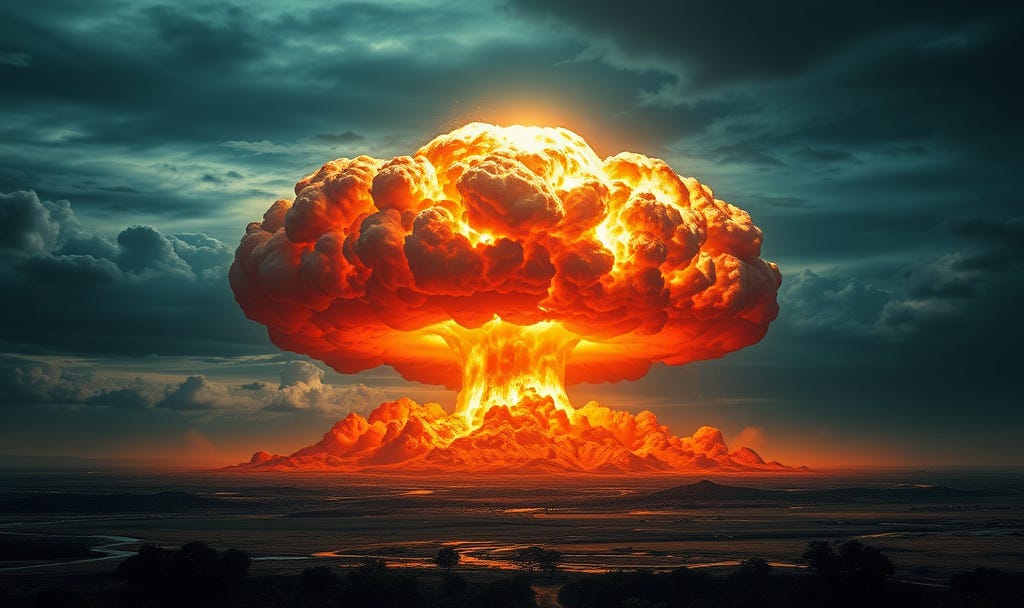
A strike on Iran’s major cities, on the order of a hundred Hiroshima‑scale weapons, would not be a regional event. It would be a planetary one.
The immediate region—spanning the Middle East and Central Asia—would face radioactive fallout, poisoned water, economic collapse, and one of the largest refugee crises in modern history. Beyond that, smoke and soot from burning cities would enter the upper atmosphere, dim sunlight, shorten growing seasons, and send food and energy markets into chaos across Eurasia and North Africa.
Globally, the effects would be cataclysmic. Iran’s position beneath the great Eurasian jet streams means the atmospheric fallout would not remain local—it would circle the planet, touching every continent.
Creating multi‑year climate disruption. Harvests would shrink across continents. Energy systems would buckle. Financial markets would struggle with the massive global depression accompanied by social unrest.
History is a testament to the fact that wars always escape the intentions of those who start them. Trump believed he was seizing the initiative. In reality, he has stepped into a trap that Netanyahu has been patiently waiting three decades to use.
What is most frightening is that for Trump this isn't about strategy—it was about a distraction. A presidency under domestic pressure reaches for the oldest trick in politics: war. But when that war involves an adversary that has calculated an unanticipated asymmetric response, the consequences will not be measured in polling numbers or headlines. They will be measured in lives, in livelihoods, in the fragile threads that hold the global economy together. Trump may believe he can trade attention at home for military theater abroad, that he can walk away when the pressure mounts. He cannot. And the rest of the world cannot either. When the calculus of political survival meets the instruments of planetary destruction, the gamble is no longer local—it is existential.