
Chinanomics 3.0
Beijing's Economic Development Shift

Chinanomics 3.0
Beijing’s Economic Development Shift
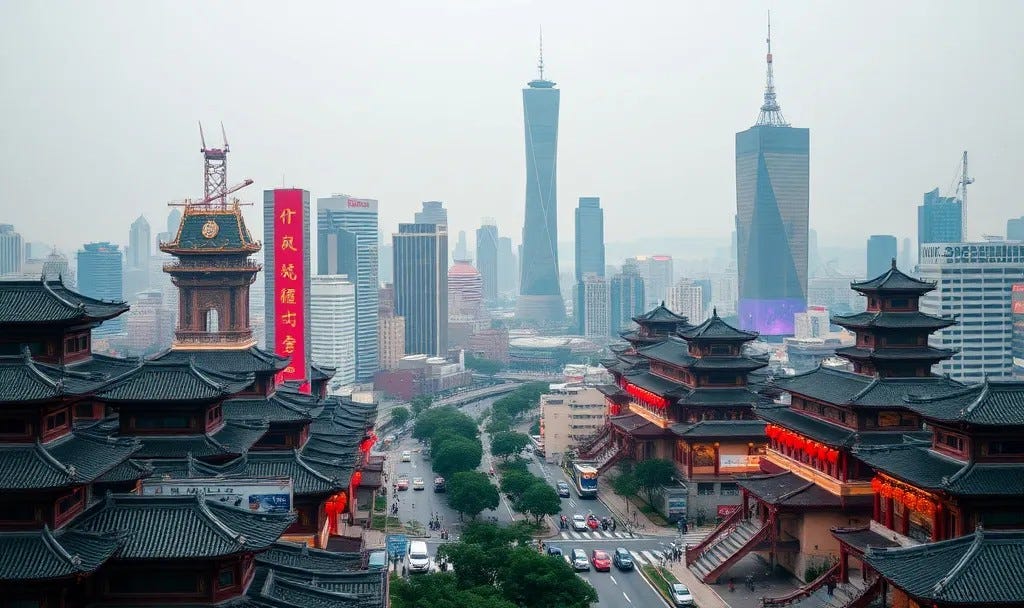
China's economic and social dynamics are part of a continuum that continues to adapt to the needs of its future while many developed nations focus nostalgically on the glories of their past.
Every solution simply creates a new set of problems. China internally and externally faces new challenges. Internally to do with the costs of its domestic development achievements. Externally due to the frictions set in motion by its economic and political successes.
The most consequential mistake many make is considering Beijing's policies separately as opposed to carefully calibrated parts of a strategic masterplan.
For example, MERICS has just put out an analysis that correctly identifies the Chinese government's Unified National Market as one of the most significant economic reforms China has taken in its 15th Five-Year Plan. It is an excellent article well worth reading but it fails to link it to other components of Beijing policies. The Unified National Market, the Six Networks initiative, industrial upgrading, codifying environmental reforms, digital governance and changes to cadre evaluation are all mutually reinforcing in terms of how China is radically reshaping its development model to address its domestic and global challenges.
The Unified National Market, for more than four decades, much of China's growth was driven by competition between provinces, cities and counties. Local governments cultivated hometown champions, protected local industries, directed investment, controlled access to land and financing, and competed aggressively for economic activity. The model delivered extraordinary growth but also produced duplication, fragmentation, overcapacity and waste.
The Unified National Market is an attempt to move beyond that model.
This is not simply an effort to remove local protectionism. It is an effort to transform China from a collection of competing regional economies into an integrated continental economy. The objective is to allow capital, labour, technology, energy, data and goods to flow according to economic efficiency rather than administrative boundaries.
The timing is not accidental. As external markets become less predictable and geopolitical competition intensifies, Beijing views the domestic market as its most important controllable asset. The leadership's goal is to link market integration directly to industrial upgrading, technological self-reliance and the development of what Xi Jinping calls "new quality productive forces."
The implications are profound.
For decades local governments effectively acted as venture capitalists. They picked winners, directed resources toward favoured enterprises and often protected local firms from outside competition. Their aim was to create a perceived legacy of accomplishment to earn promotions. The result was the creation of many successful companies but also many inefficient ones whose competitiveness depended more on local support than market performance.
A Unified National Market changes the equation.
Large and well-capitalised firms will be among the primary beneficiaries. They can optimize supply chains, production facilities and distribution networks across a national market of more than 1.4 billion people. Scale, efficiency and productivity become more important than political proximity. Guanxi and crony capitalism will not disappear, but their value declines when access is governed by national standards rather than local relationships.
Smaller firms will face a different reality. Many will no longer survive simply because they enjoy local protection. Their future lies in specialisation and efficiency, servicing larger industrial ecosystems and national champions. This is how many of Germany's Mittelstand firms operate. They dominate highly specialised niches while supplying larger industrial networks.
The result should be stronger Chinese companies that are competitive domestically and internationally. Success in a Unified National Market becomes preparation for global competition because firms must compete against the best operators from every province rather than relying on administrative barriers.
The need for reform is reflected in the scale of existing distortions. According to OECD analysis released in 2026, approximately 60 percent of Chinese firms' gains in global market share between 2005 and 2023 were attributable to government subsidies rather than productivity improvements. Chinese firms received between three and eight times more subsidies than competitors in OECD economies. Such policies accelerated industrialisation but also created inefficiencies that Beijing increasingly appears determined to address. While China has slightly different numbers and sees much of the interpretation as due to hypocritical political narratives, given Airbus and Boeing to name one example. The larger issue is that China needs to transform its thinking beyond a developing country protecting nascent industries from dominant global corporations, to a global competitor in its own right. This necessitates ending inefficient economic practices that once helped but now harm its economic progress.
The implications for local governments will be significant.
Municipalities will have to rethink their investment strategies. For decades they poured resources into local champions, industrial parks and prestige projects. Some succeeded. Many did not. Vast amounts of capital were allocated based on local interests rather than national efficiency.
Evidenced by Xi Jinping’s continued emphasis on shifting from high-speed GDP growth to high-quality development that prioritizes sustainable economic gains and technological self-reliance over raw output numbers. Underlined by an emphatic warning to government officials against superficial, debt-fueled projects and "fake construction kick-offs". Under these directives, official performance will no longer be judged on short-term GDP expansion, but rather on genuine achievements in public welfare and fiscal responsibility, with strict accountability and consequences for those who invest recklessly
This means local and provincial governments will be judged not by how many local champions they create but by how effectively they support the broader economy. The emphasis shifts from picking winners to creating conditions in which efficient firms can thrive.
This is where the proposed Six Networks initiative becomes important.
Many observers see the programme as another infrastructure stimulus. That misses the point.
Water networks, advanced power grids, computing power networks, next-generation communications, underground utility corridors and integrated logistics systems are not isolated construction projects. Together they form the physical and digital backbone of a Unified National Market.
A modern industrial economy requires more than roads and ports. It requires data to move as efficiently as goods, computing power to be used as efficiently as electricity and energy systems, capable of supporting advanced manufacturing, artificial intelligence, and automation. These networks are designed to increase productivity and reduce friction across the entire economy.
The objective is not simply more infrastructure. It is more efficient infrastructure.
At the same time, the greatest challenge remains political rather than technical.
The desire to favour local interests is deeply embedded within China's administrative culture. Local officials have spent decades being rewarded for local outcomes. That instinct will not disappear easily.
The result is the central government will rely on data, artificial intelligence, and digital governance.
If local reports cannot always be trusted, then performance must increasingly be measured directly. Real-time dashboards, national databases, AI-assisted monitoring systems and integrated data platforms will provide Beijing with mechanisms to evaluate local performance using objective metrics rather than subjective reporting.
This creates substantial opportunities for companies involved in cloud computing, industrial software, AI analytics, digital governance and enterprise data systems.
It also aligns with a broader shift in policy priorities.
Recent measures such as the Environmental Code reinforce Beijing's signal that it values quality development over the quantity of development. Environmental outcomes, technological capability, productivity, innovation and quality of life are becoming more important than headline GDP figures.
This is reflected throughout the 15th Five-Year Plan. China has targeted annual R&D investment growth exceeding 7 percent, alongside significant reductions in carbon intensity and energy intensity. The emphasis is increasingly on building a more efficient, advanced, productive, sustainable, and socially balanced economy rather than simply a larger one.
Viewed individually, these initiatives can appear rational but separate. Viewed together, they form a coherent but radical shift in China’s national development strategy, an extraordinary change .
The Unified National Market, the Six Networks initiative, industrial upgrading, codifying environmental reforms, digital governance and changes to cadre evaluation are all mutually reinforcing. They point toward a China that is attempting to optimise itself as a single integrated economic system.
Many governments today remain focused on short-term political cycles and immediate consumption. China appears increasingly focused on the fundamentals that underpin long-term competitiveness: infrastructure, productivity, technological capability, market integration and administrative efficiency.
Whether the strategy succeeds remains to be seen. Local resistance should not be underestimated. But the direction is unmistakable. China is attempting to transition from a federation of competing local growth machines into a highly integrated, technologically advanced and data-driven continental economy designed for an increasingly competitive and fragmented world.