
A Durian Transaction
An economic blue ocean for SMEs

A Durian Transaction
An economic blue ocean for SMEs
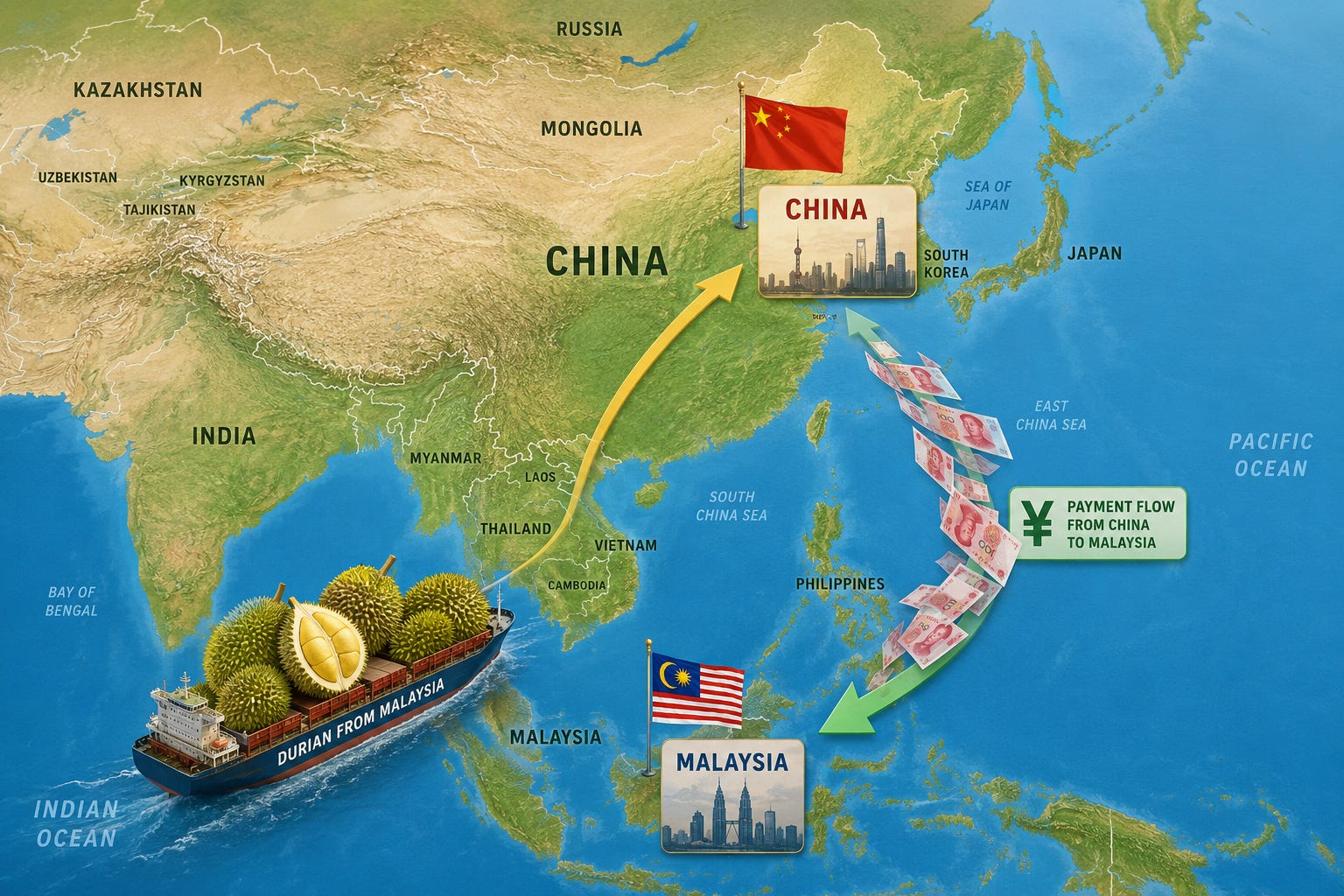
How a 43,000-yuan shipment of Malaysian fruit signals a continuing fundamental shift in cross-border transaction finance.
The Transaction That Changed Everything
In late July 2026, a Chinese durian importer sent 43,000 yuan (US$6,360) to a Malaysian supplier for a shipment of fresh Musang King. The money arrived in 30 minutes. No intermediary banks. No multiple banking charges, foreign exchange spreads or correspondent banking costs. No three-day wait.
For perishable goods, speed is survival. But for small and medium-sized businesses across the Global South, this transaction represents something much bigger. It demonstrates that a new financial infrastructure has matured to the point where many cross-border payments no longer require the traditional correspondent banking system—with its multiple intermediaries, opaque routing and settlement delays that often stretch from one to three business days.
The deal, executed by China Construction Bank’s Xiamen and Labuan branches, completed a bilateral digital currency loop, following an inbound trial earlier this year. More importantly, it demonstrated the practical power of two complementary payment infrastructures—mBridge and CBETS. Together they offer an increasingly credible alternative to the correspondent banking model that has underpinned international finance for decades.
Two Models, One Goal
mBridge: The Central Bank Highway
mBridge is a multi-central bank digital currency platform connecting the payment systems of participating economies. Launched in 2021 by the BIS Innovation Hub together with the central banks of China, Hong Kong, Thailand and the UAE, it uses distributed ledger technology to enable direct transfers between central banks without relying on correspondent banking.
The results are impressive. Pilot transactions settle in as little as six to nine seconds. Testing suggests transaction costs can be reduced by roughly half compared with conventional cross-border payment systems. By June 2026, cumulative transaction volumes had reportedly reached approximately 500 billion yuan.
Its membership has steadily expanded. The founding participants were later joined by Saudi Arabia, while Macau became a participant in June 2026. The platform reached Minimum Viable Product status in June 2024 and is now moving toward broader commercial deployment. In one notable example, a Hong Kong company paid taxes to authorities in Hangzhou through mBridge, reducing settlement time from three days to roughly thirty minutes.
CBETS (”数币达”): The Commercial On-Ramp
While mBridge connects central banks, CBETS connects commercial banks.
Launched commercially on June 16, 2026, the Cross-border e-CNY Transfer Services platform provides a unified gateway allowing commercial banks to access multiple settlement channels through a single API. If mBridge is the international highway connecting central banks, CBETS is the interchange that allows commercial institutions to enter the network without rebuilding their entire infrastructure.
The design reflects commercial realities. CBETS offers both central bank system interconnection and direct institutional access. It operates twenty-four hours a day through its Hong Kong access point. Participating banks do not need to replace existing legacy systems.
Twenty-six financial institutions joined at launch, covering Hong Kong, Macau, Singapore, Thailand, the UAE, Qatar, Laos and Brazil. Major Chinese banks including ICBC, Bank of China and China Construction Bank have established local operations across these markets, creating a practical commercial network for cross-border digital yuan settlement.
The New Economics of Cross-Border Payments. Traditional correspondent banking, using Swift messaging, often requires one to three business days to complete settlement. Payments may pass through several intermediary banks, generating multiple fees, foreign exchange spreads and compliance costs while providing limited visibility into where funds are during the process. For SMEs this can represent as much as 6%of the transaction.
mBridge compresses settlement into seconds while reducing transaction costs and providing full traceability through distributed ledger (blockchain) technology.
CBETS demonstrated its practical value by completing the Malaysian durian transaction in thirty minutes without intermediary banks while providing continuous twenty-four-hour operation and end-to-end transaction visibility.
For a Malaysian durian exporter, this means fresher fruit and faster payment. Because neither side is waiting for payment to clear. For a Brazilian coffee cooperative, a Lao textile manufacturer or a Thai fruit grower, it means that cross-border payments no longer consume a disproportionate share of already thin margins.
The Payment Middleman’s Last Stand. This new infrastructure does more than accelerate payments. It changes the economics of international trade.
For decades, many international trading houses benefited from the market barriers built into cross-border finance. Small producers often lacked direct access to overseas buyers. Payments were slow, expensive and opaque. Lawyers, consultants, banks, and accountants were needed for contracts, compliance, letters of credit, and tax issues. Large intermediaries absorbed those costs while capturing additional margins for providing market access, leaving less for the SME’s.
That source of competitive advantage is beginning to disappear. When a Malaysian durian producer can receive payment directly from a Chinese importer in thirty minutes, one important layer of intermediation becomes less valuable. Producers no longer need to accept lower prices simply because overseas settlement is costly and uncertain. They can negotiate directly with buyers, differentiate products on quality, branding or reliability and receive payment almost immediately.
This does not eliminate the role of trading companies. They still provide logistics, financing, warehousing, quality control and customs expertise. But digital settlement removes one of the major sources of value they historically provided—the friction inherent in moving money across borders.
The Malaysian durian market illustrates the transformation. Fresh durian exports to China increased from approximately US$5 million to US$37 million in 2025, with Malaysia targeting US$220 million by 2030. Rising Chinese demand explains part of the increase. Lower transaction costs and more efficient payment infrastructure help explain the rest.
The same opportunity extends well beyond agriculture. Brazilian coffee cooperatives can negotiate directly with Chinese roasters. Lao textile manufacturers can produce small custom orders for retailers in Dubai. Thai fruit growers can build long-term relationships with distributors in Shanghai without relying exclusively on large international trading houses.
These platforms do more than move money. They create transparency, build trust and allow businesses previously excluded by the complexity of international finance to compete directly.
A Blue Ocean for SMEs. The durian transaction is not an isolated success story. It signals that cross-border finance is becoming more accessible.
For small businesses across Southeast Asia, the Middle East and Latin America, many of the traditional barriers to international commerce are beginning to fall. High banking costs, settlement delays and opaque payment routes are gradually giving way to faster settlement, greater transparency and the ability to transact directly in local currencies.
The greatest beneficiaries are producers able to differentiate their products. Under the old system, much of that value was captured by intermediaries. Under the emerging model, more of it remains with those creating the product.
As Mu Changchun, Director General of the People’s Bank of China’s Digital Currency Research Institute, noted during the Summer Davos Forum in June, standardized CBETS services improve the international usability of the renminbi while strengthening risk management for cross-border capital flows. The objective is not simply faster payments. It is a more efficient and inclusive international financial infrastructure.
Challenges remain. Cross-border compliance, differing regulatory frameworks and legal interoperability continue to require careful coordination. The BIS ended its direct participation in mBridge in early 2026 as governance questions and broader geopolitical considerations increasingly surrounded the project, although the participating central banks have continued development independently.
Even so, the direction is becoming increasingly clear.
China is building a dual-layer cross-border payment architecture. mBridge provides the central bank backbone. CBETS provides commercial access. Together they reduce costs, improve transparency and make sophisticated international payment infrastructure available to businesses that previously lacked the scale or resources to access it.
For the durian importer in Xiamen, the technology is almost invisible. The payment simply arrives—fast, inexpensive and fully traceable.
For millions of small businesses across the Global South, that simplicity will prove transformative.
Traditional correspondent banking is no longer the only practical option. For participating markets and many SME transactions, digital settlement networks are outperforming legacy systems on speed, transparency and cost. As that network expands, the businesses that create value rather than merely profit from financial market barriers and their customers will be the biggest beneficiaries.
This is great news - a system that facilitates trade rather than extracting rents.
Good news for all about the West’s banking monopoly of its fee on trade outwitted with China’s system .
Free trade not fee trade!