
AI
Rhetoric & Reality

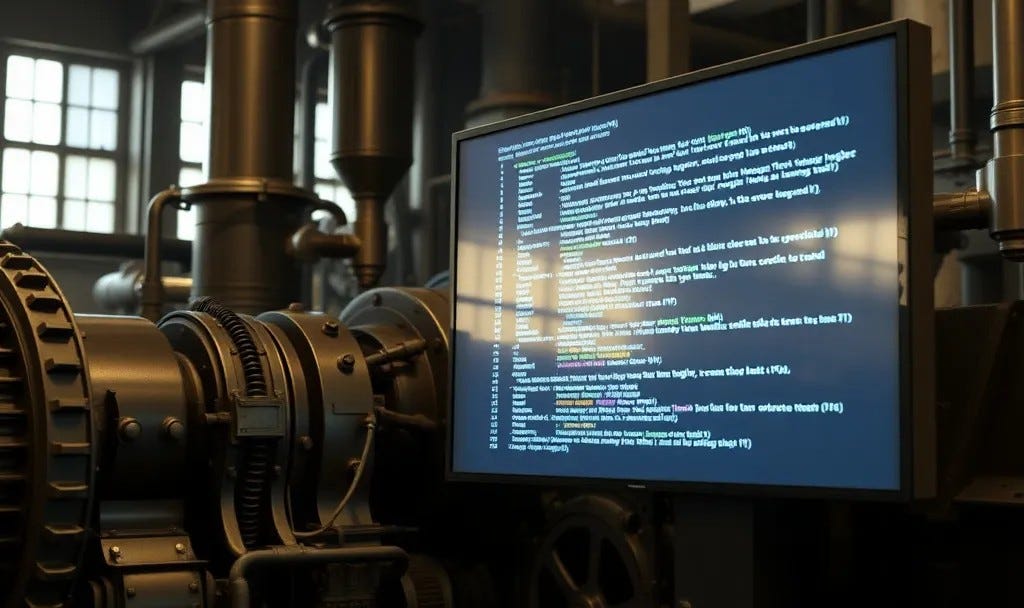
The AI and Industrial Revolutions are the same. Both represent paradigm shifts in the organization and operation of society, labor, and power. Both carry immense potential and profound risk. Neither is inherently good nor evil. The moral weight lies not in the technology itself, but in how human beings choose to deploy it, regulate it, and distribute its gains.
The internal combustion engine, when harnessed to a tractor, accomplished in a single day what ten men with horses and plows could barely finish in a week. That single innovation unleashed the rural labor dividend. Millions of people migrated to cities and factories. The same engines that powered the trains and steamships, enabled colonial expansion, extracting wealth from entire continents and concentrating it in the hands of a few Colonial powers. They were also responsible for the slow, methodical fossil fuel poisoning that threatens our planet's climate. But, the engine was not evil. It was a tool. It amplified human intent, whether for exploitation or innovation, for conquest or cooperation.
Over decades, through ideological change, strikes, labor movements, policy battles, and social upheaval, the productivity gains from that engine were eventually more evenly distributed. They gave rise to a middle class that had never existed before. They enabled mass education, home ownership, leisure time, and consumer choice. The standard of living for ordinary people in industrialized nations rose to levels that would have been unimaginable to their agrarian ancestors. The point being the outcome was not predetermined. It was fought over.
AI is precisely the same kind of force. It is a new engine, but instead of plowing soil, it plows through data. Instead of moving physical goods, it processes information, makes decisions, and shapes the social world. It will generate its own dividends, its own disruptions, and its own concentrations of power. The question is not whether AI will change everything. It will. The question is who will control it, who will benefit from it, and who will bear its costs.
But here the analogy becomes more complicated, because AI is not a neutral tool in the same way a tractor is. A tractor interacts with dirt. AI interacts with human society, human history, and human bias. Its fuel is data, and if that data is corrupted, the AI will be corrupted. This is not a hypothetical risk. It is an engineering reality. Garbage in, gospel out.
An AI trained on historical hiring data will not transcend the prejudices that it encounters. It will replicate them. It will learn that men are better suited for leadership because men held leadership roles in the data. It will learn that certain universities produce better candidates because hiring managers preferred them. It will faithfully encode the biases of the past and then deploy them at scale, with speed and efficiency no human could match. This is not malice. It is pattern recognition. But the consequences are the same as malice.
Facial recognition systems trained predominantly on light skin fail on dark skin. Predictive policing algorithms trained on historical arrest data, reflecting biased enforcement patterns, will send more police to already over-policed neighborhoods, generating more arrests and confirming the algorithm's original bias. Loan approval systems trained on decades of redlining will deny mortgages in the same communities, starving them of capital and then using the resulting poverty as proof that the denial was justified. This is the feedback loop. The AI does not merely reflect the past. It actively constructs a future that reflects its biased training.
Compounding this problem is opacity. These systems are often black boxes. Even their creators cannot fully explain how they arrive at specific decisions. When a tractor breaks, a mechanic can open the hood and trace the failure to a faulty valve. When an AI denies someone a loan, a job, or parole, tracing the decision back to its source is often impossible. This creates an accountability vacuum. If no one can explain why the AI made its choice, no one can be held responsible for it. The programmer points to the data. The company points to the algorithm. The data aggregator points to the terms of service. The injured party is left with no recourse.
For example the concept of “fairness”, will become a problem not a solution. Fairness is not a technical parameter. It is a philosophical argument. Different definitions of fairness conflict. Is it fair to ensure equal outcomes across groups? Or is it fair to ensure equal opportunity, even if that leads to unequal results? It is difficult to optimize AI for more than one concept and if you do, you may inject your own bias. The choice of static definitions applied to dynamic value judgements, will be made in private by engineers and executives, not in public by the people whose lives will be shaped by their choices.
This is the central struggle of the AI age. The Industrial Revolution was fought on picket lines, in union halls, political backrooms, and legislation. Workers could see the machine, they knew the owners. They could strike against it and them. They could organize. The AI revolution is fought in code, in data sets, and in proprietary algorithms. The machinery is invisible. The decision-making is opaque. The power is concentrated in ways that are difficult to even perceive, let alone challenge.
None of this means AI is evil. It is not. It is a tool, like the engine, like the tractor. It will create wealth, enable discovery, and open possibilities we cannot yet foresee. But it could also concentrate power, automate inequality, and encode bias unless there is active public policy intervention. The outcome depends entirely on what we do now. It depends on whether we demand transparency. It depends on whether we fight for accountability. It depends on whether we insist that the data feeding these systems is representative and that the systems themselves can be audited.
The engine was not destined to create a middle class. That was fought for. AI is not destined to create a fair society. That too must be fought for. The technology is neutral.
The struggle is not.
Industrial Revolution removes the exchange value of human labor. AI and robotics remove the exchange value of human minds. Yet the Western economic theories and financial engineering practises are firmly footed in such exchange values. The classical Confucius school of thoughts asked for all things centered around humans, to solve the problems of human lives, to make all people live comfortably. Before the social, political, economic, and financial thinking and practices have a foundation to switch, simply changing the technology is to jump off a cliff first, then start designing a parachute. Technology may be neutral in the hands of the wise, but it is not neutral in the hands of the evil.
An excellent analysis Einar