
Global Energy Shock
China's Position Amid Structural Constraints

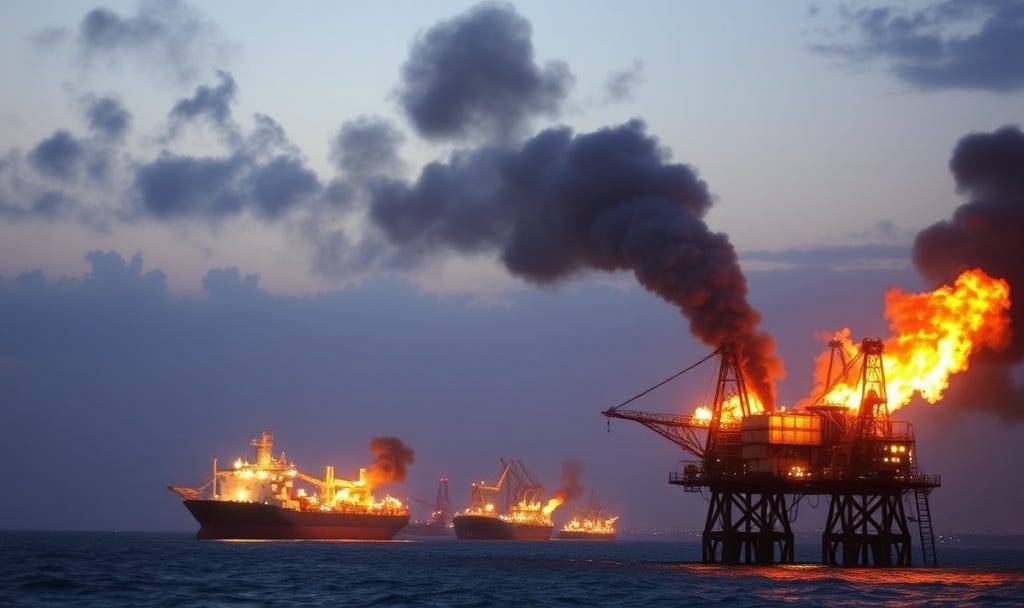
Global Energy Shock: China's Position Amid Structural Constraints
Global energy markets are undergoing a systemic shock centered on the disruption of the Strait of Hormuz, through which roughly 20–21 million barrels per day of oil and a significant share of global LNG normally transit. This is not a temporary dislocation but a structural break, exposing the hard physical limits of energy infrastructure operating with minimal redundancy.
Alternative pipelines cannot replace lost seaborne flows. Saudi Arabia's East-West pipeline possesses 7 million barrels per day of nameplate capacity, but February 2026 loadings from Yanbu averaged just 1.4 million barrels per day, with domestic refining and terminal constraints limiting actual availability. The UAE's Fujairah bypass offers approximately 1.5 million barrels per day with limited spare capacity. Iraq, Kuwait, and Qatar remain structurally dependent on Hormuz with minimal alternatives. Against a disruption of 16–19 million barrels per day of exports, these measures can mitigate but not replace lost flows.
The International Energy Agency's March 2026 Oil Market Report estimates that crude and product flows through Hormuz have plunged to a "trickle," with Gulf countries cutting production by at least 10 million barrels per day. The IEA projects global oil supply to plunge by 8 million barrels per day in March 2026, an unprecedented scale that cannot be quickly resolved given minimal short-term elasticity.
Simultaneously, global natural gas markets face parallel shock. Qatar, accounting for roughly one-fifth of global LNG supply, has declared force majeure on exports with liquefaction facilities shut down. The resulting tightening of 5–10% of global LNG supply triggers significant secondary effects: as gas becomes scarce, power systems and industrial users switch to oil where possible, adding incremental demand into an already undersupplied oil market, creating a reinforcing feedback loop.
Two Analytical Frameworks
Within this crisis, two distinct frameworks have emerged to project price consequences.
The linear-extrapolative framework scales historical price responses to the unprecedented current disruption. The 1973 oil crisis saw a 7–9% supply disruption produce a fourfold price increase; the 1979 Iranian Revolution and Russian invasion of Ukraine, each involving 3–5% disruptions, produced roughly twofold increases. Applying this scaling to a double-digit global supply shock yields equilibrium projections of $340–$510 per barrel from a pre-crisis baseline of $80–90, with stress scenarios extending toward $595–$680.
The institutional consensus framework—represented by the IEA, Wood Mackenzie, and Wells Fargo—arrives at substantially more tempered projections. Wood Mackenzie, employing detailed supply chain modeling, projects rebalancing will require Brent crude to reach at least $150 per barrel, acknowledging that $200 is "not outside the realms of possibility" in a worst-case prolonged conflict. Wells Fargo identifies $130 per barrel as the threshold where sustained oil shock becomes recessionary for the U.S. economy.
The IEA emphasizes multiple mitigating factors: a 400 million barrel coordinated stock release, demand destruction of approximately 1 million barrels per day, and potential non-OPEC+ output increases. Their methodology focuses on observable empirical anchors—current global stocks of 8.2 billion barrels, refining capacity utilization, and tanker tracking data—producing a more tempered outlook focused on managing a multi-month supply gap.
Reconciling the Frameworks
The divergence reflects fundamental differences in analytical approach that can be reconciled through careful synthesis. The physical reality of a 10–15 million barrel per day supply gap is unprecedented and cannot be quickly resolved. Yet the price mechanism need not follow a simple linear multiplier. Strategic stock releases, demand destruction, and non-OPEC+ supply increases collectively create a buffer that, while insufficient to prevent severe price increases, may cap the extremes.
The most credible synthesis acknowledges that both approaches capture partial truths. While conventional institutional analysis indicates Price Discovery will likely occur in the $150–200 range under prolonged disruption. However, the linear-extrapolative framework serves as a critical stress-test for policymakers. If institutional models prove too optimistic—if demand destruction occurs more slowly than assumed, if strategic stocks prove logistically difficult to deploy, if financial amplification intensifies—prices could migrate toward the upper end of the linear projection.
China's Relative Position
If the Strait of Hormuz remains closed for three months or longer, the world—and therefore China—will face severe economic pressures and structural damage. Energy costs will compound through interconnected systems: a fourfold increase in oil can translate into a four to sixfold increase in staple food prices as each stage of production and transport passes on increased expenses. Industrial supply chains will fracture. Inflation will tighten monetary conditions. Social stability will come under pressure across vulnerable economies.
Yet within this globally painful scenario, China occupies a position that is significantly more resilient than that of other major economies. This relative advantage rests on three structural buffers.
First, strategic petroleum reserves. The IEA estimates Chinese crude stocks at approximately 1.23 billion barrels—roughly 15% of global observed inventories. While this buffer covers only a few months of imports at pre-crisis levels, it provides critical insulation during the most acute phase of disruption, allowing China to manage releases strategically while other import-dependent nations face immediate scarcity.
Second, coal as a domestic fallback. China possesses the world's largest coal reserves and production capacity, with coal currently accounting for approximately 60% of electricity generation. Unlike Europe, Japan, or South Korea—which depend heavily on imported natural gas for power generation—China can substitute coal for gas in electricity production, reducing exposure to LNG spot market prices that will reach historic highs as European and Asian buyers compete for dwindling cargoes. This does not eliminate pressure—coal prices will rise, and environmental costs are real—but it provides an option that pure energy importers lack entirely.
Third, an accelerating transition pathway. The crisis, while damaging, accelerates China's long-term strategic shift toward domestic energy sources. Rapid expansion of nuclear capacity—with approximately 20 reactors under construction, more than any other nation—reduces future import dependence. Renewable deployment continues at unprecedented scale, with wind and solar capacity growing faster than any major economy. Looking further ahead, China's substantial and sustained investment in fusion power research—including the Experimental Advanced Superconducting Tokamak (EAST) and participation in the ITER project—positions it to potentially benefit from next-generation energy technologies that would permanently break dependence on fossil fuel imports.
Comparative Resilience
The contrast with other major economies is stark. The European Union and United Kingdom face acute industrial contraction driven by high gas prices and import dependence, with limited coal capacity and anti-nuclear policies in key member states limiting their fallback options. Japan and South Korea, with near-total reliance on imported energy, are particularly exposed to LNG market tightening and possess minimal domestic alternatives. Emerging markets face the most acute stress, as rising energy and food costs translate into currency depreciation, balance-of-payments crises, and social instability. Even the United States, despite its domestic production base, faces stagflationary pressures as global prices drive inflation across traded goods and commodities.
This relative advantage does not render China immune. Rising import costs will pressure industrial margins. Food prices will increase. Export demand will weaken as trading partners enter recession. The strategic reserves that provide temporary insulation are finite and must be managed carefully. Coal substitution involves real trade-offs in terms of emissions and local pollution. The transition to renewables, nuclear, and ultimately fusion is a multi-decade project that offers little relief in the immediate crisis.
But the difference is one of degree rather than kind—and the degree matters enormously. For pure energy importers, if the Hormuz closes for more than two-months it would create an existential shock with limited policy options. For China, it represents a severe but manageable crisis in which reserves, coal, and an accelerating transition provide buffers that other nations simply do not possess.
Conclusion
The divergence between analytical frameworks should inspire humility rather than dogmatic adherence. The IEA's empirical rigor, Wood Mackenzie's supply-chain modeling, Wells Fargo's macroeconomic analysis, and the linear-extrapolative focus on physical constraints each capture different dimensions of a complex reality. The truth likely lies somewhere between the cautious institutional consensus and the recognition that unprecedented disruptions can produce unprecedented outcomes.
Without rapid restoration of supply through the Strait of Hormuz, the risk extends beyond energy markets to the stability of the global economic system itself. The adjustment will be painful, prolonged, and unevenly distributed. All nations will suffer damage. But China enters this crisis from a position of relative strength—its reserves providing temporary insulation, its coal capacity offering a domestic fallback, and its accelerating transition toward nuclear, renewables, and fusion charting a path beyond fossil fuel dependence. In a world of universal pain, the best position is to be less exposed than others, with clearer options for long-term escape. That is precisely where China finds itself.
Good analysis, the supply-side mechanics are solid. But I think it’s the wrong angle.
The question isn’t whether China can weather the shock, it can, for the reasons you identify. The question is what the shock was designed to accomplish. Iran, Venezuela, and the Russian shadow flows aren’t just supply sources. They are the operational infrastructure of yuan-denominated oil settlement, a decade of work building non-dollar procurement architecture in China’s largest import category.
If Kharg restarts under dollar settlement conditions, if Russian oil flows back into dollar-cleared trades (Washington is already engineering this, sanctions waivers issued March 13), and considering Venezuela is already back selling oil in dollars, China’s resilience won’t matter beyond the short term. Simply put, the architecture it built to escape the dollar system will be greatly degraded and, perhaps no longer able to function at scale. Surviving the crisis while losing that infrastructure will be a serious blow to China and it’s ambition to run a parallel system outside the dollar. when you look at the cumulative effect of Trumps actions from his first year in office it seems self-evident that those actions are aimed at dismantling the non-dollar system with a bid to force China back in line.