

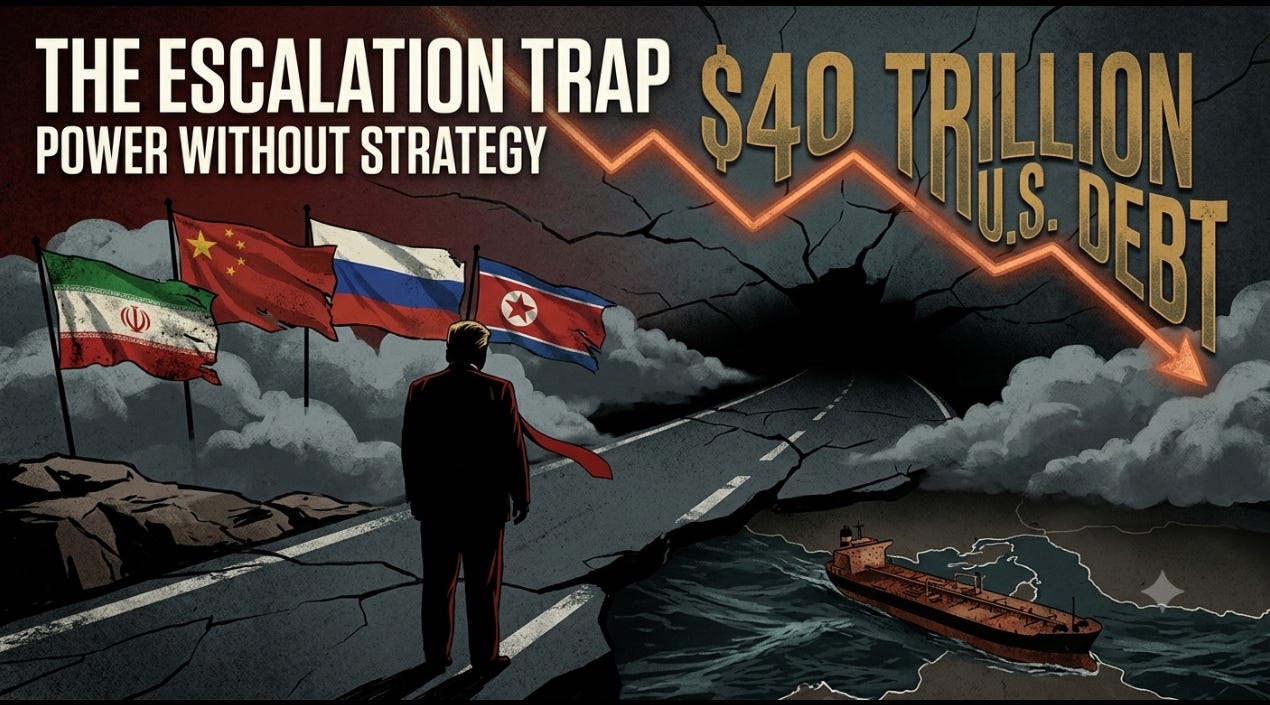
Trump’s foreign policy rests on a single approach: apply maximum pressure and force rapid capitulation.
The assumption is that American military and economic power is so overwhelming that targets have no possible choice but surrender. When that does not happen, Trump doesn’t adjust his strategy—he escalates it—a central flaw in his coercive diplomatic strategy.
The results are not strategic successes, but feedback loops. Military pressure fails to produce political concessions, so Washington adds economic pressure through sanctions and financial restrictions. When those fail, Trump doubles down adding more military and economic pressure. Iran is the clearest example. After decades of sanctions, Tehran has developed oil-smuggling networks, alternative financial channels, and trading relationships outside the US-controlled system. New US sanctions can reduce Iranian revenue and raise the cost of trade, but they cannot guarantee capitulation. If sanctions could topple Iran, there would have been no need for a war, they would have done so already. So the threat of more sanctions is just distracting hyperbole.
The point Trump can’t seem to comprehend is that Iran can retaliate with pressure points of its own. Roughly 20 million barrels of oil used to pass through the Strait of Hormuz daily. Disruption does not simply hurt Iran; it raises energy costs globally. Washington can impose costs on Tehran, but Tehran can impose costs on the global economy that in turn hit American consumers. This cost and effect asymmetry makes his strategy irrational.
Rather than reflecting and adjusting to his primary failures, Trump doubles down by using secondary sanctions against direct and tangentially connected countries. Instead of forcing compliance these countries start looking for alternatives that sideline US influence and controls.
China has no intention of letting American sanctions determine its energy policy. It has trade relationships, financial channels, control over critical minerals and manufacturing inputs from nuts and bolts to chemicals, as counter-leverage.
India imports roughly 85% of its crude oil and must balance energy security against the risk of losing access to the US financial system. Thus rather than forcing compliance will push it to quietly consider alternatives to US domination.
The Gulf states want Iran contained but do not want a war fought in their territories or against their energy infrastructure. Spare production capacity is irrelevant if the physical routes for moving oil are blocked.
As seen by the recent defense pact between Turkey, Saudi Arabia, and Pakistan, they are creating alternatives to an unreliable but demanding American pressures.
This exposes the deeper weakness: the sanctions strategy assumes the dollar system is so dominant that every major economy must comply. But, the more Washington weaponizes the system, the more major economies are incentivized to develop alternatives. The irony is hard to miss. The sanctions Washington is using as a blunt instrument to enforce its economic dominance is actually accelerating the de-dollarization that will undermine it.
The same logic applies to America’s fiscal situation. Federal debt has passed 40 trillion, with roughly 13 trillion requiring refinancing. If rolled over at current rates at the same maturities, the additional interest burden could add over 600 hundred billion to an interest bill already near 1 trillion. Keep in mind that the 2026
Federal Budget is expected to run a 1.9 trillion deficit meaning Washington is running a structural deficit while facing increased interest payments for additional borrowing. The parallels to Bernie Madoff and his Ponzi scheme come to mind.
Every dollar spent servicing debt is unavailable for defense, infrastructure, tax relief, or domestic programs. Higher energy prices compound the problem for American consumers. Middle East instability pushes oil prices up, which fuels inflation, that limits how quickly the Federal Reserve can cut rates, while it increases interest rates on rolled over and new Treasury debt. The fiscal squeeze has become a strategic downward spiral where time is the enemy.
This pattern repeats across multiple theaters. In Ukraine, promised leverage has not produced a rapid settlement. North Korea has an expanding nuclear capability and stronger ties with Russia. Meaning it has no incentive to surrender a deterrent it considers essential to regime survival. With China, economic pressure has produced countermeasures rather than capitulation. With Iran, military and economic pressure has produced escalation rather than surrender. The United States can impose costs, but it cannot guarantee compliance—a distinction that is becoming increasingly apparent to all except Trump.
Trump’s assumption that American power automatically converts into American outcomes is flawed. Power is merely an input; strategy determines whether it produces the desired result. Instead of reassessing when pressure fails, Trump doubles down on it, expanding the effects to other countries, thereby creating a larger coalition of countries with an interest in resisting American pressure. China wants financial and technological autonomy. India wants energy security without sacrificing access to the US financial system. The Gulf states want security without becoming a battlefield. Iran wants regime survival. North Korea wants nuclear deterrence. Russia wants to outlast Western political commitment. None of these objectives requires defeating the United States—only surviving long enough for the economic and political costs to force change in Washington.
This is where domestic constraints merge with foreign policy. Inflation remains politically damaging, debt and interest costs are rising, while Trump’s poll numbers are plummeting as the midterms approach. Trump’s response has been to flood the news cycle with new threats, sanctions, and bombast. But distractions do not create strategic success. If oil prices rise, Americans pay more for gasoline. If inflation persists, Americans pay more for food and housing. If interest rates remain high, borrowing costs increase. If debt-service costs rise, Washington has less money for everything else.
The feedback loop becomes clear: economic pressure produces retaliation, retaliation produces military escalation, escalation disrupts energy and financial markets, market disruption produces inflation, inflation keeps interest rates higher, higher rates increase debt-service costs, and reduced fiscal capacity shrinks strategic flexibility. The problem is not that America lacks power, but that the math doesn’t work.
Trump is running multiple open-ended pressure campaigns against adversaries whose primary objective is survival. This is fundamentally different from negotiating with a party that needs a deal. Iran does not need to defeat the United States; it needs to survive. North Korea does not need to defeat the United States; it needs to preserve its regime. Russia does not need to defeat the United States; it needs to outlast Western political commitments. China does not need to defeat the United States; it needs to avoid economic subordination. The United States has greater resources, but its adversaries operate on different time horizons. Trump needs quick results; they need only endurance.
That is why the strategy is running out of runway. Every escalation intended to force concessions, instead creates more resistance. Every new sanction increases the incentive to develop alternative financial channels. Every military deployment creates another financial obligation. Every energy market disruption creates another set of inflationary pressures. Every increase in debt service reduces Washington’s alternatives and ability to support its defence, people and growth.
US power remains, but the ability to convert it into outcomes is being squandered. This is the anatomy of this strategic collapse—is not about the collapse of American power, but of the effectiveness of simplistic coercion tactics that assume power can substitute for strategy.
There is no power, it's a mirage.
All this talk like America having the largest consumer market in the world does not pass scrutiny. In America people are living paycheck to paycheck, pilling on debt to survive, with one out every 5 children going hungry, and the middle class being consistently wipeout since the 1980's with policies like "trickle-down economics" in which cutting taxes for the wealthy and corporations, economic benefits are supposed to “trickle down” to everyone else. Well obviously that has not happen and never will so a proper description of the American consumer market is that it's the largest group of people that cant afford the product and services they buy and if people cannot afford the things that they buy, they cannot afford what factories across America produce trapping the society in this economic spiral of doom, when the ball stops rolling as soon as wages cant keep up with inflation.
Now this policy is intentional and happened at the same time with the Reagan and Thatcher administrations.
Since beginning of time, the rich and the powerful have ruled the world, the kings and queens, the lord and the ladies etc, owned the workers and the land. If any slave objected he or she got flogged or hanged and that kept them in order. These individuals driven by greed long since realized that the real wealth in this world, is land, the resources that lie under it and the people that live above it. Those are the real source of wealth in the world and has been what wars have been fought over, for centuries.
People often assume that religion has something to do with it, failing to understand that religion is just a tool, to keep people in order and accumulate wealth. Historically priests have raped women and children and swindled land out of people on their death bed, a practices that is still live and well today along with information gathering. That's why churches are placed around all the military industrial complexes in China for example. The almighty needs information.
The religion scheme is simple, keep people from believing in themselves and their ability to succeed, and to get them to believe in something else, divine higher being or some person in a leadership role. stick a person in a dress ( there is a reason for that, priest, judges, royalties etc. if you for example want to get people to drop their guard completely, put on a white jacket, like a doctor or something similar ) and have him reside the same text over and over and over again, because if people do believe in themselves and their ability to succeed, nothing can stop them, with all these churches just being front for a cabal of sorts. Education is the same, it's a tool to manipulate people, history, language and their meaning etc.
Long story put short, people in debt are slaves to their employers and creditors, you are not allowed to own anything but you can borrow and subscribe. Slavery never has been abolished, it's just been modernized and the peak of such policy is reflected in America, which is the most modernized slaved society on the planet, followed by EU member states, UK, Canada and Australia.
When it comes to the military, it's built to generate profits, not win wars, the war college generates not strategists but sociologists who are turned into admirals, Reside Sun Tsu while preparing to fight the nation that wrote it ( ridiculous ). you will have to go pretty far into last century to find a strategist in America.
On top of that you dont generate profits by winning wars but to continuously be in a state of conflict, economically draining the adversary ( and your own tax payers ) you are conflict with, which forces it to deal with IMF or development bank of sorts and be subjugated that way and resource drained from within, if you loose you simply freeze the conflict, create an armistice of sort to be able to return at a later date or alter the strategy and start salami slicing the government from within, or use a border flash point that was intentionally created for that purpose.
China now provides nations with an alternative which is a thorn in those power side since it undermines the approach that has been taken for the last century, if not longer.
People should approach analysis of the Iran issue with which strategy generates most profit, not by religion or who is winning or loosing, or who has stronger or weaker military because that's how the US government works. Why do Americans enable and turn a blind eye to the holocaust in Gaza, ( this is not a war as western media portrays it, for an war Palestine needs to have a military, it doesn't )? Because the real wealth in this world, is land (Trump and others wants to turn Palestine into the "Riviera of the Middle East" ) , the resources that lie under it ( oil, gas, magnesium, potash, bromine, coal, iron ore, bauxite, marble, and other minerals ) and the people that live above it, which will be slaughter until their ranks are so low that they can be subjugated and become slaves or reallocated and Israel settlers move in to replace them. This is what wars are fought over and have been fought over for centuries. Religion is just a tool to achieve that objective.
The fundamental problem with societies driven by greed like America, is that greed devours everything until there is nothing left, so while the greed has been fighting all these campaigns to feed itself, it devoured the very capabilities that enabled it to do so from within and now all branches of the military are collapsing, The Navy cant built ships or even engineering them, The Army cant even build Howitzers anymore, very basic equipment, which any factory in the states should easily be able to make so it has to source it from abroad, New Aircraft's only exists on paper, or have not even reached their Initial/Full Operational Capability (IOC) a problem that the block upgrades on for example Fat Amy ( F-35 ) are trying to solve, to meet the IOC capabilities that were promised and sold to congress and the public routinely dropped. On top of that like garbage pail kids, USAF has to cannibalized aircraft graveyards for parts, to keep planes and jets flying etc.
America has never had any power, it's just a poor sprite commercial in which it pretends to be something it is not. When nations realize that, they can easily get from under America's hold over them, choose they to do so.
Thank you, Prof. Tangen! A welcome analysis. Let’s unpack this a bit - two parts: “the anatomy of this strategic defeat,” and “simplistic coercion tactics that assume power can substitute for strategy” taking the latter first. I would say a typical error for USA is assuming air power substitutes for military power. It does not. It blows a lot of stuff up, but is incapable of capturing any territory. As well, their primary instrument for forceful pressure around the world, their 20th Century aircraft carriers, are held far offshore by missile threat. Regarding this supposed “strategic defeat,” no defeat of any kind or any size has ever interrupted American coercion and manipulation of affairs in every country around the world. They simply apply the next tool, through the next appropriate agency, to maintain hegemonic pressure all over the world. Contrast their manipulation of the world via Military Command centres and hundreds of bases, with China’s development and finance services via BRI and other programs. Apparently America is doing everything possible to either break their world reserve currency, or break the world with it. Either way, that currency’s value and utility evaporates and they lose the exorbitant privilege of raking in the world’s savings to fund their extravagant lifestyles and military power.