
Technofeudalism
Those Who Would Be Our Masters

Technofeudalism, and Those Who Would Be Our Masters
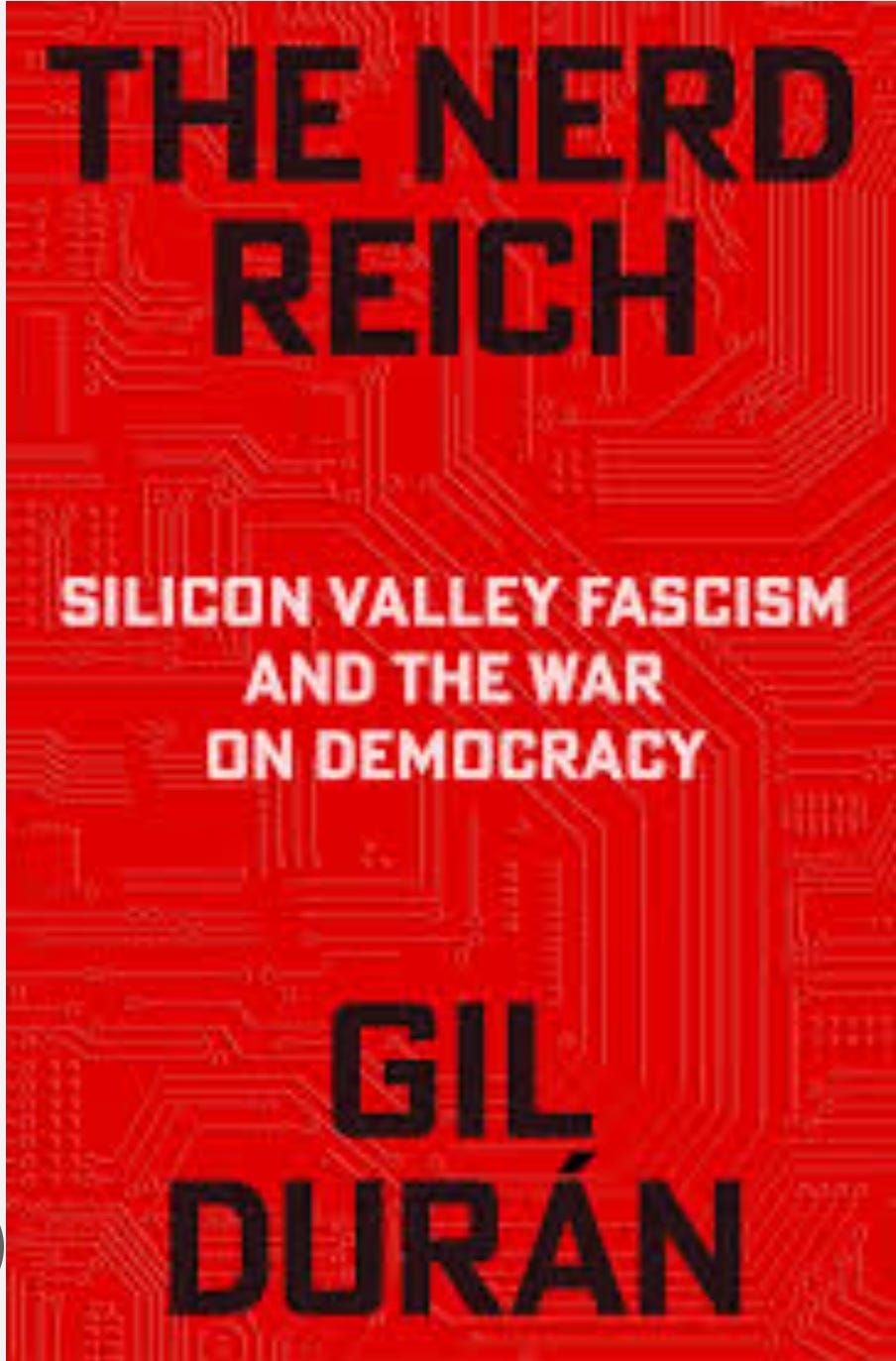
Gil Duran's interview about ‘The Nerd Reich’
(https://www.npr.org/2026/08/10/nx-s1-5925350/the-nerd-reich-tracks-the-unmasking-of-silicon-valleys-true-politics)
poses a stark question: what happens when some of America's most powerful technocrats decide democracy is an impediment to their vision and profits?
A faction of Silicon Valley elites has moved beyond seeking to influence governments. They now aspire to run them—as feudal lords of techno-states.
The Dark Enlightenment they advocate is rooted less in philosophy than in technological and economic hierarchy. Those with power should rule those without. Democratic institutions, in this view, are not safeguards but obstacles—repugnant constraints imposed by an ignorant populace that must be managed.
These ideas once lived on fringe technology blogs. They now occupy the corridors of power because the billionaires who embrace them have the resources to turn ideology into political reality.
Peter Thiel is central to this story. His political financing propelled J.D. Vance from the Senate to the vice presidency, forging a direct conduit between Silicon Valley wealth and executive authority. Duran highlights the "network state" movement, where wealthy investors seek to establish privately governed communities beyond democratic and regulatory oversight. These projects may never achieve sovereignty; their significance is ideological. They embody the belief that capital, technology and expertise should determine how society is organized.
Palantir and its CEO, Alex Karp, provide the clearest example of where this thinking leads.
Palantir is not merely a software vendor to governments. It is deeply embedded in defense, intelligence and security. Karp has argued that Silicon Valley has an affirmative obligation to participate in national defense and that artificial intelligence will fundamentally transform military power.
In April, Palantir published a 22-point manifesto based on Karp's The Technological Republic. It calls for Silicon Valley to embrace hard power, argues that AI weapons development is inevitable, and rejects what it describes as cultural relativism and "vacant pluralism." Critics, including Duran, have called the document an expression of "technofascism."
That charge is not mere rhetoric. Karp explicitly links technological superiority, military power and national destiny. His argument is that the technological elite has a responsibility to build the instruments of state power—not as neutral suppliers, but as shapers of how that power is wielded. The manifesto transforms corporate philosophy into political doctrine.
Palantir's significance, therefore, is not that it proves every claim Duran makes. It is that it demonstrates how the ideology he describes operates in practice: private capital develops critical technology; that technology becomes integral to government and military power; and the company then argues openly that the technological elite should help determine how that power is used.
This is distinct from the robber barons of the industrial age, but the hubris is the same. Carnegie, Rockefeller and their contemporaries amassed extraordinary wealth and influenced government. They did not, however, possess today's capacity to control information, data, surveillance and the digital infrastructure upon which governments increasingly depend.
The emerging danger is not simply that billionaires might capture government. It is that governments may become dependent on the billionaires who control the technology through which they exercise power.
That is the issue at the heart of Duran's argument. The contest is no longer simply between left and right, or between business and government. It is increasingly about whether the people or the elites will remain the ultimate source of political authority. Whether technological power will be able to dictate the terms under which citizens exist.
God, father gave Jesus authority over heaven and earth. All these plans being done in the dark or coming to the light all of this will be defeated and wiped away by my Lord and Savior Jesus God uses bad people to bring about good things and at the top of the pyramid is president, Trump possessed by many devils, but he is serving God‘s purpose and when he is removed, and I believe by impeachment or sudden death, all of this will be collapsed in the western world. By the way I love your work and I follow you on YouTube. have a great day and be blessed.
"The People" lost political authority when politics became a spectator sport. And they lost agency by being so shut in by debt that they can't participate in community affairs.