
The $23 Trillion Question
Can Anyone Rebuild What China Has?

The $23 Trillion Question
China’s Real Engine Isn’t AI or EVs—It’s the Stuff You Never See
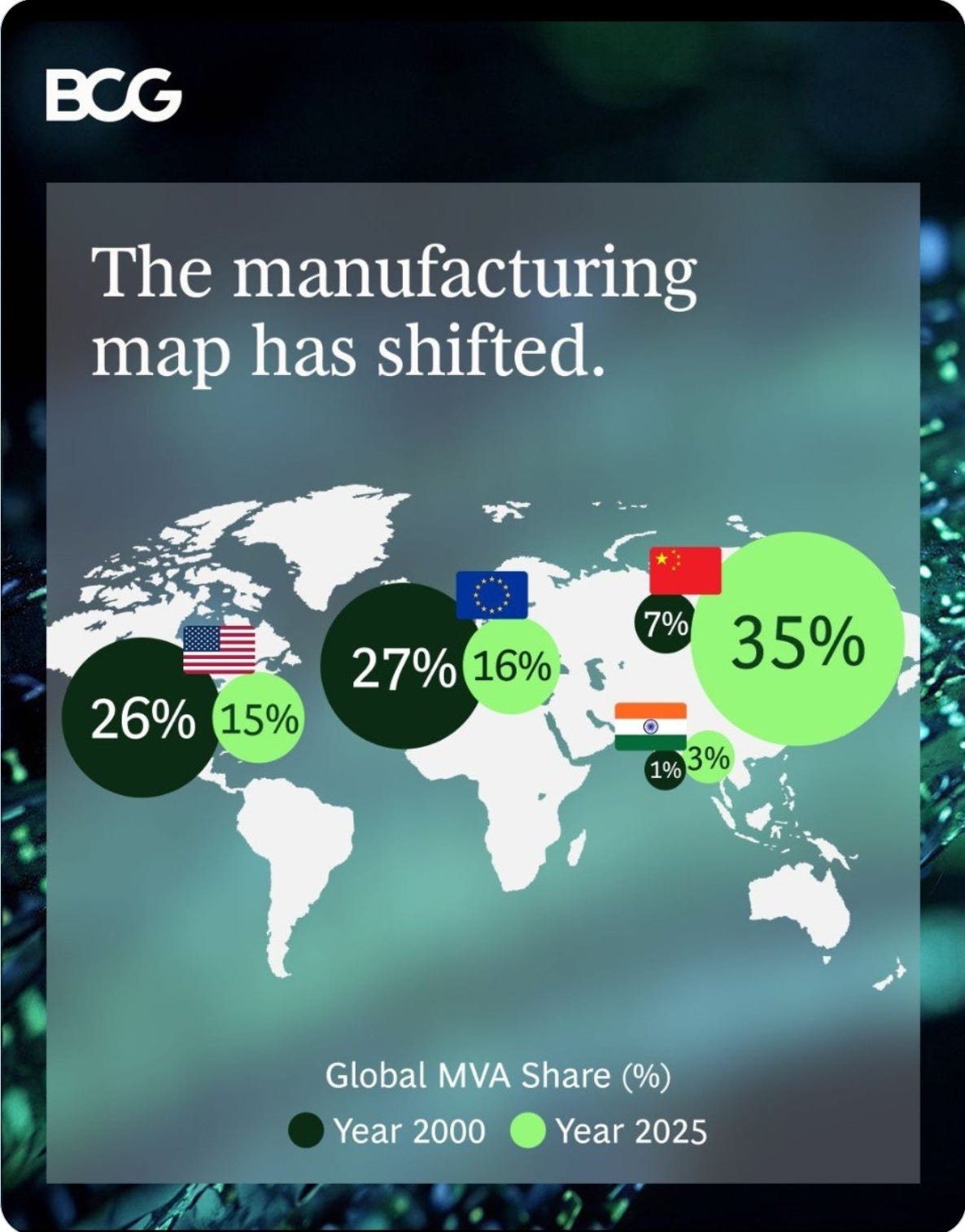
China dominates global manufacturing. Everyone knows that. But most people are looking in the wrong components. They see semiconductors, artificial intelligence, and electric vehicles—the high-tech, high-glamor, high margin industries that make the daily headlines. These are the peaks of China’s economic mountain. But mountains don’t float. They sit on foundations. China’s true strength isn’t what it assembles—it’s what it supplies. We’re talking about chemicals, steel, bearings, fasteners, pharmaceutical ingredients, industrial ceramics, pumps, motors, packaging. Thousands of products consumers never see and politicians rarely mention.
This is the $23 trillion question: Can anyone rebuild what China has built underneath?
Time to Follow the Numbers
China’s intermediate-goods exports hit 11.24 trillion yuan in 2023—47.3% of everything China sells to the world. China has been the world’s largest exporter of these invisible components for twelve straight years. China accounts for 46% of global chemical sales, 67% of the global automotive battery market, over 90% of cathode and anode materials for batteries, 54% of the world’s steel, and 45% of active pharmaceutical ingredient filings to the FDA.
In Asia, China is the dominant supplier for 20 of the 22 most heavily traded components. And the trend is accelerating. Intermediate goods were 42% of exports in 2015; by 2025, they’ll hit roughly 46%. So while on its face consumer goods dropped from 37% to 31% over the same period. The point is China isn’t just assembling products for the world anymore. It’s supplying the industrial inputs that make those products possible.
Three Mechanisms Behind the Machine
People explain China’s rise through two stories: the visible hand of the state (Five-Year Plans, subsidies, infrastructure) and the invisible hand of entrepreneurship (Shenzhen’s startups, private companies, relentless competition). Both are correct. Neither tells the deeper truth.
First, volume over margin. Chinese companies learned that Western capital markets aren’t interested in low margins on large capex: while Chinese companies saw the opportunity to make investments work using scale. A chemical plant running at 90% capacity with a 3% margin generates more total value and more cash for reinvestment than a plant at 60% capacity with a 12% margin. Scale produces more scale. Higher volume supports investment. Investment expands capacity. Capacity reduces unit costs. Lower costs win more market share. The process feeds itself.
Second, supplier density. The Shenzhen model shows the principle perfectly. Manufacturers, suppliers, engineers, logistics companies, and tooling firms operate in close proximity. Inventory requirements plummet. Transport costs are cut. Prototypes can be modified in hours, not weeks, months,or years. Production problems are solved in a day instead of a month. Goods ship the same day they’re ready. This isn’t just about lower labour costs—it’s about speed, being faster and more efficient than your competitors. This principle operates across every industrial sector. Supplier density creates an economic advantage distributed across thousands of companies and millions of transactions. It’s a system, not a factory.
Third, investment financing. Western capital markets aren’t interested in funding low-margin, high-volume industrial businesses. Equity investors demand high returns. Banks view these businesses as unattractive and risky. Companies have no choice, they have to move upmarket, reduce capacity, or exit entirely.
China operates differently. In 2025, the six largest state-owned commercial banks extended more than 9.4 trillion yuan in new loans. ICBC alone had 6 trillion yuan in outstanding technology loans and 6.7 trillion yuan in green loans. These loans flow through provincial banks and local credit channels into the industrial base. This isn’t a subsidy. It’s a financing system willing to provide long-term credit where private capital markets won’t go.
What Everyone Gets Wrong
The central mistake is confusing China’s technological frontier with its industrial foundation. Everyone focuses on semiconductors, AI, and EVs—the visible peaks. They are not the mountain beneath them. A semiconductor fab requires industrial ceramics, specialty pumps, precision equipment, and high-purity chemicals. An EV needs batteries, cathode materials, anode materials, chemicals, metals, motors, bearings, and thousands of other components. China’s position in intermediate industries creates advantages that ripple upward. The ability to rapidly prototype in Shenzhen using locally available components—this is the real advantage. Rapid iterations pushed by competition and consumer demand. Costs drop. Scale accelerates. Investment follows.
This creates a strategic problem for competitors. If China dominated only in AI, export controls could target that. If China dominated only in finished goods, tariffs could target those. Intermediate goods are different. They’re distributed across thousands of industries. They’re essential. They’re frequently low-value relative to the finished product. They’re largely invisible to consumers. You cannot replace a global supply chain by banning one product. You cannot tariff an industrial chemical without raising costs for manufacturers that use it. You cannot move a bearing factory without recreating the suppliers, tooling companies, logistics networks, engineers, and customers around it.
A 2026 EY-Parthenon study estimated the US, eurozone, and UK would need an additional $23.6 trillion over 25 years to substantially reduce reliance on Chinese supply chains—roughly $940 billion per year. The study’s conclusion isn’t that substitution is impossible. It’s that building a comparable ecosystem would take time and be massively expensive. Industry estimates suggest Chinese products typically have a 20–100% factory-gate price advantage over Western equivalents. The challenge isn’t just to build intermediate goods factories. It’s to build factories, suppliers, workers, logistics networks, engineering expertise, and the accumulated knowledge from decades of competition.
Developed Nations: Three Structural Problems
First, costs. Labour costs are higher in the West. Construction costs are higher. Environmental and regulatory requirements are stricter, costlier, and more time consuming. A Western producer must accept lower margins or achieve sufficient scale to offset the disadvantage. Neither is likely.
Second, political economy. Subsidies come from taxpayers. Voters want results they can see. Semiconductor or battery production is politically visible. Fasteners, industrial chemicals, or intermediate materials are not. Approximately 70% of post-2020 EU subsidy actions have targeted strategic technology rather than industrial commodities.
Third, capital markets. Private investors won’t finance 3% margins over 20-year horizons just because businesses are strategically important. Governments can provide initial capital but can’t guarantee political support remains for decades. Once subsidies face pressure, companies will again face the need for higher returns. Management is then forced to move towards higher-margin products. That undermines the volume strategy required to replicate China’s ecosystem. Chinese companies operate within a different financing environment. They’ve demonstrated willingness to sustain investment through low profitability and, in some cases, losses.
China’s Vulnerabilities (and Their Counters)
The headwinds are real. Demographics: China’s population is aging; wages have risen. Debt: levels are high; the property crisis undermined confidence—real estate has been estimated at 70% of household wealth and 25% of GDP. Automation: the West is still competitive in AI and advanced robotics; a sufficiently automated Western factory could compete without the same labour intensity.
Here’s the counter: Automation is not an ecosystem. A factory can be automated. A supplier network cannot. Automation makes an individual plant more productive. It does not create the thousands of surrounding companies that supply components, tooling, chemicals, packaging, logistics, and technical services. Nor does it reproduce the relationships that allow rapid problem-solving.
China is leading in robotics adoption—more than half of new industrial-robot installations in 2023. The same ecosystem that supports low-margin manufacturing is adopting automation to maintain advantages. And credit remains available as they understand the strategy. If credit tightens, the model could face a reckoning. But if Chinese companies maintain economic centrality—and they are—they remain supportable.
What Happens Next
The likely outcome isn’t supply chain collapse. It’s asymmetrical dependence. Western countries will build capacity in high-technology industries where margins are higher and political support stronger. They’ll diversify final assembly. They’ll establish alternative suppliers in Vietnam, India, and Mexico. But the intermediate-goods foundation will remain in China. The final product will say “Made in Vietnam” or “Made in the USA.” But the fasteners, chemicals, machinery components, battery materials, and packaging will come from China. The ship delivering the goods will have likely been made in China. The supply chain will be diversified geographically while remaining concentrated industrially. That’s not eliminating dependence. It’s redistributing visible dependence.
Three Variables Challenges
China’s financial health: if debt produces a significant credit contraction, or state banks redirect lending away from manufacturing, the model could weaken. Available evidence indicates continued credit availability. Sustainability isn’t guaranteed, but financing remains.
Geopolitical shock: major conflict, sanctions, or catastrophic disruption could accelerate Western efforts to reduce dependence. Such a shift would be disruptive and inflationary but could change political calculations. Governments may accept much higher costs if dependence becomes a national-security issue.
Technological breakthroughs: automation and AI could advance faster than expected. If they substantially reduce Western production costs, China’s scale and labour-cost advantages could narrow. That would change reshoring economics. It’s possible. It’s not the most likely outcome—especially as China continues leading in robotics adoption, digital efficiency, and sophisticated manufacturing ecosystems.
The Bottom Line
China’s rise through state policy and entrepreneurial innovation is not a false narrative. Both mattered. But neither tells the entire story. The deeper foundation was the accumulation of low-margin, high-volume intermediate-goods manufacturing—chemicals, steel, bearings, fasteners, pharmaceutical ingredients, industrial machinery, packaging, components. Thousands of products consumers rarely see but manufacturers cannot operate without. China built scale, supplier density, logistics networks, technical knowledge, and financing mechanisms capable of sustaining investment through low-margin periods. It connected these capabilities to emerging technology industries. This foundation is now deeply embedded in the global economy.
The challenge for the West isn’t simply to build factories. It’s to reproduce an ecosystem that makes it efficient. That requires capital, workers, suppliers, infrastructure, technical knowledge, customers, and time. It also requires political systems capable of sustaining low-return investment through multiple election cycles.
That is the real barrier to replication. The West may reduce dependence, create alternative suppliers, and build domestic capacity in strategically important industries. But there’s a difference between diversification and replacement. The most likely outcome is continued asymmetry. The West will keep talking about de-risking. It will keep investing in semiconductors, AI, and batteries—high-profile, high-return technologies. It will keep mistaking visible technological progress for comprehensive reindustrialisation. Meanwhile, the less visible industrial foundation will remain deeply connected to China. That is the part of China’s economic rise still misunderstood. And it remains China’s most formidable strength.
Thank you, prof. Tangen! That’s exactly the issue: supplier density, essentially an industrial park containing every necessary input ingredient. Another large factor is China’s entirely different layout of large factories, where product changeover is easy and rapid. And as you mention, the likely disruption of “investment through multiple election cycles.” These so-called governments are subject to frequent ideological capture of the levers of power through the churn of administrative cycles, thus long-term advancement of society is unlikely. Imagine voting every four years on the government of your electric utility, with the possibility that in the next cycle they could be forced to switch to DC current.
One very impressive side of China's economic development in the last few decades is its rapid increase in environmental standards. Pollution standards in China are now similar to those across the west. You just need to look at a picture of the skyline of any major Chinese city compared to a couple of decades ago. The smog has disappeared despite massive increases in manufacturing output.
China has achieved the trifecta many industry lobbyists claimed was impossible, rapidly increasing environmental standards, rapidly increasing real wages and rapid economic growth.