
The Munich Security Conference
A discussion with Glenn Diesen

The Munich Security Conference: A conversation with Glenn Diesen
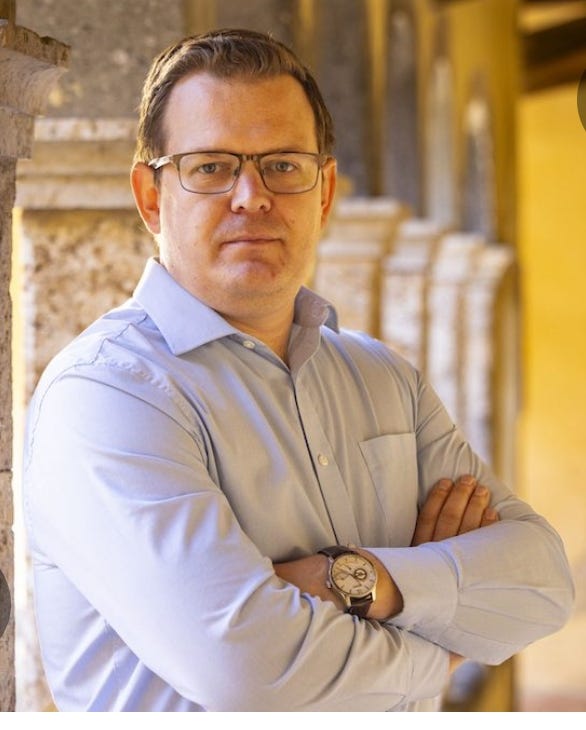
Munich was not about shared values or transatlantic renewal. It was a demand for global subservience with American power — not American principles.
Created in 1963 as the Wehrkunde conference, the Munich gathering once symbolized Western cohesion. During the Cold War it projected unity against a common adversary; after the Cold War it became a consolidated platform for liberal internationalism. That post-1991 consensus — built around NATO expansion, humanitarian intervention, and a self-described “rules-based international order” — laid the groundwork for the crises we now confront. NATO expansion contributed to the war in Ukraine. Humanitarian interventions, often justified on moral grounds, frequently destabilized the states they claimed to protect. The rules-based order, presented as universal, operated in practice as a one-sided ideological framework. Unfortunately, the contradictions of that era have now matured into the absurdities of the present.
What has changed is not the reliance on power, but the rhetoric surrounding it. In Munich, the language of shared principles was evicerated. Secretary of State Marco Rubio framed the moment as a civilizational struggle, dismissing the “end of history” mindset of the 1990s as a “dangerous delusion.” He argued that mass migration and fragile supply chains threaten Western cohesion. The implication was clear: stability requires discipline, not debate. An open demand that the world return to a colonial era. Diplomacy must give way to strategic obedience. The fig leaf of liberal universalism was discarded, naked use of power to retain power is its own justification.
At a time of global economic uncertainty, Washington’s message to Europe centers on “de-risking” from China, raising defense budgets, tightening export controls, and enforcing sanctions. These are not proposals for multilateral negotiations. They are directives framed as necessities. Rubio blended admonition with reassurance — urging Europe to “revitalize an old friendship” and accept US tariffs, while criticizing European welfare spending and migration policies as threats to stability. The tone was transactional: solidarity in exchange for compliance.
Europe’s dilemma is structural. The European Union speaks of “strategic autonomy,” yet its security architecture rests squarely on U.S. power — U.S. intelligence, logistics, defense guarantees, and increasingly U.S. energy. German Chancellor Friedrich Merz captured the paradox when he declared that the U.S.-led rules-based order is “over,” even as he appealed for renewed transatlantic solidarity. Europe recognizes change but lacks the capacity — or will — to act independently.
The war in Ukraine has sharpened this dependence. Although European defense spending has increased, procurement continues to channel funds toward U.S. defense contractors. Washington's self-serving logic: European security must depend on American hardware and strategy, but not support. At the same time, European elites are naively insisting that diplomacy must follow battlefield outcomes, sidelining the Westphalian logic of negotiated balance in favor of escalation first and settlement later.
Economic contradictions compound the strategic ones. Washington demands economic distance from China, yet Europe’s industrial core — particularly Germany’s export-driven manufacturing sector — remains deeply intertwined with Chinese markets. European leaders acknowledge the tension but have offered no coherent path forward. They invoke autonomy rhetorically while aligning with U.S. sanctions, deployments, and Indo-Pacific strategies in practice.
This leadership gap is increasingly visible. Analysts at Chatham House observed that half the Munich audience applauded Rubio out of “relief” that his tone was less confrontational than previous remarks by JD Vance. Relief is not confidence; it signals lowered expectations. Europe appears less a partner shaping strategy than a vassal adjusting to it.
Washington’s frustrated designs extend beyond Europe. The Global South has not aligned with U.S. sanctions on Russia. BRICS expansion, the growth of local-currency trade, and efforts to diversify away from the dollar challenge the dollar-centric system.
The issue, rather than adapting to the multipolar reality, the United States has escalated enforcement: more secondary sanctions, tighter export controls, and increased naval pressure in the South China Sea. The response reflects a political culture shaped by a “never admit defeat, always double down” ethos associated with figures like Roy Cohn, Donald Trump’s political mentor.
Strategically, the focus is explicit: contain China. Official U.S. documents — from National Security Strategy texts to Pentagon assessments — identify Beijing as the central challenge. The objective is to isolate China technologically, constrain it economically, and surround it militarily. The CHIPS Act, outbound investment screening, AI export controls, and alliances such as AUKUS form a coherent containment architecture. Rubio reinforced this framing in Munich, arguing that “Europe must survive” in a world defined by U.S.–China competition.
This logic extends even to smaller states. A recent White House Emergency Declaration naming Cuba as a threat also identified China and Russia as “malign actors,” reinforcing a Cold War–style framing in which weaker countries — Cuba, Venezuela, Colombia, Denmark, Panama — become pieces in a broader strategic contest aimed at containing Beijing and isolating Russia.
The projection of strategic coherence abroad contrasts sharply with the reality of instability at home. The United States is mired in permanent political conflict. Tariffs deployed as instruments of leverage and nationalism disproportionately burden the bottom 60 percent of Americans. Courts contest executive authority. Public trust erodes as the Epstein Files inflame partisan tensions. Inflation and rising costs deepen frustration as the country approaches a constitutional crisis in the lead-up to the November elections.
Domestic ideological currents and personalities reinforce this trajectory. Elbridge Colby, architect of the 2018 National Defense Strategy, advocates prioritizing confrontation with China, even if it means sacrificing Europe. Marco Rubio pushes expansive sanctions and a hard line on Beijing while blaming immigration for domestic instability. Stephen Miller openly advances a racist pro-Israel nationalist authoritarian agenda. Vice President J. D. Vance aligns with tech financiers such as Peter Thiel and Elon Musk, who have openly advocated privatizing key state functions and concentrating their decision-making power.
Meanwhile, Democrats remain closely aligned with corporate interests seeking to preserve open international markets under their influence.
Across party lines, a narrow set of interests dominates, while America’s debt, infrastructure, education system, and long-term economic resilience are ignored.
Powerful actors reinforce this direction. Financiers, tech titans, and think tanks fund candidates and shape policy. Peter Thiel backs political figures and benefits from government contracts through Palantir. Elon Musk operates at the intersection of military contracting, satellite infrastructure, and communications networks, receiving government payments for services once performed directly by the government. The Heritage Foundation’s “Project 2025” outlines plans to centralize executive authority, politicize the federal bureaucracy, while pushing a foreign policy that advocates a Hunger Games system of global vassal that prop up America's hegemony.
Taken together, these elements suggest design rather than improvisation: a world organized into a hardened American interest bloc, enforced through technological and logistical chokepoints, financial weaponisation, forced industrial realignment, and civilizational narratives.
Munich did not disguise this direction; it clarified it. The expectation is obedience, to present Europe and the Global South with a binary choice. But, power without legitimacy invites resistance. Europe hesitates because it is divided. The Global South diversifies because it seeks autonomy. China deepens partnerships rather than retreating. And the American public, weary of foreign entanglements and domestic strain, questions the cost of perpetual confrontation.
The Munich Security Conference once symbolized consensus within the West. Today it signals something else: not an invitation to cooperate, but an ultimatum to comply.
The answer in short is for Europe and the rest of the world to reject Trump's narrow minded self serving agenda by joining together. A show of unity threatening overwhelming economic sanctions against America would end the current Trump travesty and ensure that the future would focus on a multipolar world that seeks solutions not conflict.
https://www.google.com/url?rct=j&sa=t&url=https://www.youtube.com/watch%3Fv%3DII0pgmhgEk8&ct=ga&cd=CAEYACoUMTgwMDI3ODA3ODA3NjIyNTYyNjAyGjI2ZGNlOGMwNzJmNjYzZjA6Y29tOmVuOlVT&usg=AOvVaw1CUBH4l2J8lQ98rarErAjN
I am not expecting much of a change in terms of the EU sticking with the USA (the "great Caucasian alliance"). The EU countries, UK and USA are colonial powers. They are "birds of the same feather". And... as they say: "Birds of the feather flock together."
A Letter to Einar Tangen
On Munich, power, and the quiet question beneath structure
Dear Mr. Tangen,
I read your recent reflection on the Munich Security Conference with great care. Not merely for its geopolitical argument, but for the deeper structural intuition it carries.
What your piece captures most clearly is not simply the persistence of power, but the gradual separation between power and the legitimacy that once made it feel natural.
For much of the postwar era, global order rested on more than capability. It rested on belief - a shared assumption, whether fully conscious or not, that authority and mutual benefit were broadly aligned. Power was present, certainly, but it was embedded within a narrative that made cooperation appear voluntary rather than compelled.
What Munich seemed to reveal was not the emergence of power in its raw form - power has always been present - but the thinning of that narrative layer. The language of shared purpose appeared less central than the language of necessity, discipline, and alignment. This shift does not invalidate the strategic concerns of any nation, nor does it reduce complex decisions to simple intention. Rather, it reflects a structural transition in which legitimacy can no longer be assumed to accompany power automatically.
From Washington’s vantage point, its actions are stabilizing - preserving order in the face of fragmentation. From the vantage point of others, those same actions appear as preservation of hierarchy. These perceptions are not mutually exclusive. They arise naturally from positional reality.
Europe’s posture, as you noted, reflects this tension vividly. Its desire for autonomy exists alongside deep structural interdependence formed over decades. Similarly, the diversification underway across the Global South and the expanding partnerships elsewhere do not necessarily signal rejection, but adaptation - a quiet effort to ensure agency within an evolving landscape.
What Munich revealed, perhaps unintentionally, was not the collapse of any order, but its transformation. Authority is becoming less inherited and more negotiated. Alignment is becoming less assumed and more contingent. Legitimacy, once ambient, must now be actively cultivated.
This moment need not be understood solely as confrontation. It may also be understood as maturation - the gradual movement toward a world in which stability emerges not from singular centrality, but from balanced recognition among multiple centers of agency.
Your article brings into focus an essential truth: power alone can sustain structure for a time, but only legitimacy sustains it across time.
Munich did not create this reality. It illuminated it.
Thank you for articulating what many sense, but few express so directly.
With respect and appreciation,
A fellow observer of structure and its quiet transformations.